The west side of a composite deck in El Cajon can look washed out while the same boards under an eave in Encinitas still look rich. That contrast is not a dirty deck. It is UV and heat working on the cap, with San Diego dust and marine film stacked on top.
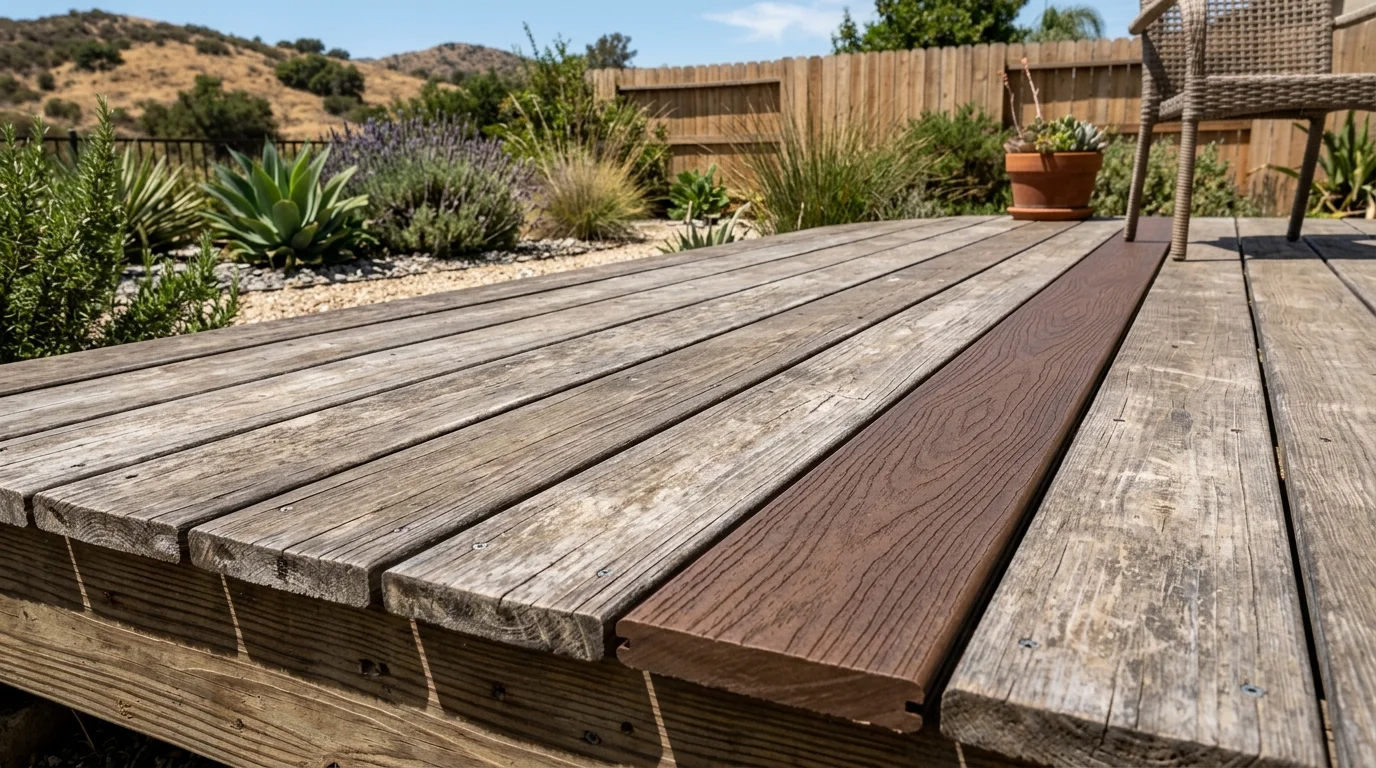
Fade is UV and heat, not dirt, and this county has both
Composite deck fading is a color change in the board itself. Sunlight breaks down pigments and polymers at the surface. Heat speeds that work. Dirt, salt, and irrigation minerals sit on top of the board. They make a faded deck look duller, but they are a different problem.
San Diego County gives boards both loads at once. Coastal yards from Imperial Beach through Pacific Beach, La Jolla, Encinitas, and Carlsbad sit in marine air. Salt and a cool morning layer coat the surface. Inland yards in Escondido, San Marcos, Santee, El Cajon, and Ramona take a longer, hotter afternoon. A west-facing deck in those inland valleys spends the brightest hours in full sun. The same board line in a north-facing Coronado courtyard does not.
That is why a page written for any city fails here. Encinitas and El Cajon do not share the same sky, the same salt, or the same afternoon bake. If you compare composite vs wood decking in San Diego, wood greys as the grain weathers and wants stain. Composite does not grey the same way. It shifts toward a flatter version of the color you bought. The structure can still be sound. The look is what changed.
Heat movement is a separate issue. Boards that cup, hog, or gape are a framing and expansion story. Color loss is not that story. If the boards also feel sprung or the fasteners are walking, read our notes on composite deck boards warping in San Diego and treat movement first. Fade on a flat, quiet deck is a surface and sunlight problem.
A simple check helps. Pull a planter, a doormat, or a grill pad that has sat still for a season. If the hidden patch is darker and the open field is pale, you are looking at light, not mud. If the whole deck looks chalky and a rinse turns the water brown, you are looking at film. Many yards have both. Clean the film before you judge the color.
Capped vs uncapped boards, and why the cap is the fade story
Most composite boards sold now carry a polymer skin, the cap, over a wood-plastic core. Color, UV blockers, and stain resistance live in that skin. The core is structure and bulk. When people talk about Trex deck fading in sun, they are talking about what happened to that cap, or to an older board that never had one.
Uncapped boards mix wood fiber at the walking surface. Wood fiber weathers. Oils work out. UV then lightens the mix. Those decks often show a broader, earlier color shift than a modern capped line. Capped boards still change. The cap slows the shift and keeps the change more even, as long as the skin stays intact.
Scratches, scuffs, and a burned grill ring matter because they cut through the cap. Once the core shows, that spot will not weather like the field around it. Sanding a capped board to “restore” color is the wrong instinct. You are thinning the only layer that holds the look.
Line and generation matter more than the brand name on the receipt. Trex, TimberTech, and other makers sell more than one cap recipe. A budget grooved board and a thicker, multi-color cap are not the same product. For a line-by-line read, use our Trex vs TimberTech in San Diego comparison, then open the care sheet for the exact SKU on your invoice. Do not borrow rules from a neighbor’s deck. The neighbor may be on a different cap.
Warranty years, fade percentages, and “never fades” claims belong to the manufacturer’s current documents, not to a blog. Read the sheet for your board. Keep the original order, the color name, and the install date. Those three things are what a maker asks for if you later open a fade claim.
When you are choosing new composite decking, look at samples outdoors in your own yard, not only in a warehouse aisle. Leave a sample on the west rail for a week. Compare it to the piece you kept inside. That is the honest preview for this county’s light.
West-facing inland decks vs shaded coastal ones
Stand on the deck at 3 p.m. in August. If you are in Ramona, Poway, or the El Cajon valley, the walking surface is taking the long western shot. Dark boards run hot. Heat and UV stack. Color flattens first on the open field, the stair treads, and the rail cap that never sees shade.
A shaded coastal deck tells a quieter fade story and a louder cleaning story. Eaves, two-story walls, and the marine layer cut the UV hours. Salt, dust, and organic drip take their place. Eucalyptus, ice plant, and irrigation overspray leave a film that looks like bleach until you wash it. The boards under a patio table in La Jolla can look richer than the uncovered strip along the glass. That is shade, not a better batch of lumber.
South-facing decks in Mission Hills, North Park, and the mesas get a long, even dose. East-facing decks take morning sun and often look more even. North-facing decks against a house wall can stay darker and grow more organic film. Pool edges add splash and mineral rings that people read as fade. Rinse those on their own before you decide the board has lost color.
Uneven fade is the tell that furniture and rugs write. A pot that never moves, a synthetic rug, and a doormat print a dark rectangle. The field around it keeps taking sun. Move the pieces a few times a year if you want the color to travel together. A grill without a mat can scorch a cap. That mark is heat damage, not UV fade, and cleaning will not lift a melt.
If you are planning shade, a cover changes the UV hours on the boards under it. It also draws a line between covered and open color. Decide that on purpose. A full cover, a partial sail, and a bare west rail will not age as one surface.
What cleaning actually lifts: dust, organics, and mineral film, not lost color
How to clean a composite deck in this county starts with what is on it. Santa Ana winds drop grit. Coastal air leaves salt. Inland sprinklers leave a white mineral crust. Leaves, pollen, and food grease sit in the grooves. All of that dulls a board. None of it puts pigment back into a cap that UV has already lightened.
Sweep first. Grit in the grooves acts like sandpaper under a brush. Then wet the boards so the cleaner does not dry in the sun. Work in the morning, especially inland. A soapy mix on a hot Santee deck flashes off before you can rinse it, and dried cleaner leaves its own haze.
What you are lifting:
- Fine dust and soil in the grooves
- Organic film from leaves, mildew, and drip
- Salt crust on coastal decks
- Hard-water spots from irrigation
- Grease near the grill
What you are not lifting: the original factory color, once UV has changed the pigment. A clean faded deck looks even and honest. It does not look new. That is the right expectation.
A small test patch saves a full-weekend fight. Pick a board that sits in full sun. Wash one end. Let it dry. Compare. If the washed end is only brighter by dirt, you have film. If both ends stay the same pale, you have fade. If the washed end turns blotchy, stop and read the maker’s sheet before you touch the rest.
Do not coat, stain, or oil a capped board because a wood-deck habit told you to. Many makers treat extra finishes as a care violation. If you want a color change that cleaning cannot give, that is a product conversation with the board brand, or a replacement conversation with a licensed pro, not a Saturday stain project.
Manufacturer wash rules beat a pressure washer. Confirm the method with the brand
A composite deck pressure wash is where good decks get scarred. High pressure, a tight fan tip, and a hot afternoon can etch the cap, strip the texture, and leave tiger stripes that look worse than the dirt you meant to remove. The repair is then cosmetic only in the sense that the board still holds a person. The look is permanent.
Trex, TimberTech, and every other major line publish a care page for a reason. Those pages name the wash method, the tools, and the products they allow for that SKU. Use that page. Do not copy a neighbor’s soap, a big-box “deck brightener,” or a setting that worked on concrete. Confirm the method with the brand on your invoice. If you cannot find the sheet, call the maker with the color name and the year.
A pattern that stays inside most care sheets, without inventing a PSI figure the ledger does not carry:
- Soft brush, not a wire brush
- The cleaner the maker lists, or a mild soap they allow
- Rinse with a garden hose or a washer kept on a wide fan, far from the board
- Never let cleaner dry on the surface
- Skip sand, metal shovels, and solvent dumps
Cut ends, hidden fasteners, and grooved faces trap slurry. Rinse until the water runs clear. Leftover cleaner in a groove becomes a streak the next time the sun hits it.
If a pro is washing the deck as part of a larger visit, ask them to follow the same maker sheet. The independent crew you get matched with is licensed and insured. They still should not invent a wash recipe that the board brand forbids. Harsh cleaning is one of the faster ways to turn an even fade into a blotchy one, and blotchy is harder to live with.
When fade is cosmetic and when it is a warranty talk with the maker, not the installer
Even, slow lightening across a whole sun field is usually cosmetic. The deck is doing what outdoor polymer does in this light. Clean it. Live with the weathered tone, or plan a future resurface if the look no longer fits the house.
Talk to the board maker, not the installer, when the color change is sharp, blotchy, or out of line with the care sheet. Typical flags:
- One run of boards much paler than the rest from the same order
- Chalking that returns right after a correct wash
- Cap peeling, flaking, or showing a different core color
- A burn, melt, or chemical spot that is not dirt
- Fade that the maker’s own warranty language describes as covered, after you read that language
The matched local pro did not formulate the cap. Labor warranties, when a pro offers one, cover workmanship. Fade and stain terms, when they exist, sit with Trex, TimberTech, or whoever extruded the board. Open that file with the maker. Keep photos of the hidden patch under a planter, the full elevation, and the product ID. Do not sand first. Sanding can end the conversation.
Replacement of tired boards is a different path. Like-for-like board replacement usually does not require a permit in San Diego. Replacing structural members (ledger boards, joists, beams, posts) often does, especially if the repair changes the loading or configuration. The independent crew matched to the job checks before quoting and pulls the permit when required, in its own name. Inside the City of San Diego, current permit information sits with Development Services. Unincorporated county addresses go through the county, not the city.
If the faded surface is also soft, bouncing, or stained at the ledger, stop treating it as a wash weekend. That is deck repair and restoration territory. Targeted repairs and structural rebuilds are scoped by the pro on site. Confirm any contractor’s license on the CSLB license lookup before work starts.
You will not get a single published “average lifespan” that is honest for every board in every yard. Coastal salt, inland heat, shade, and how the deck is washed all change the look. Ask the maker for the current care and limited-warranty terms for your line. Ask a licensed local deck builder to look at the framing if the boards are old enough that the hardware and ledger deserve a check too.
When to call us
Call when fade is the least of it: soft boards, a stained ledger, a scarred cap you want replaced, or a full resurface in a west-facing inland yard. Deck Pro SD matches you with licensed, independent local deck builders. We do not build, wash, or warrant the boards ourselves. Call us at (858) 400-4918, leave a message, and we’ll connect you with a licensed local deck builder.