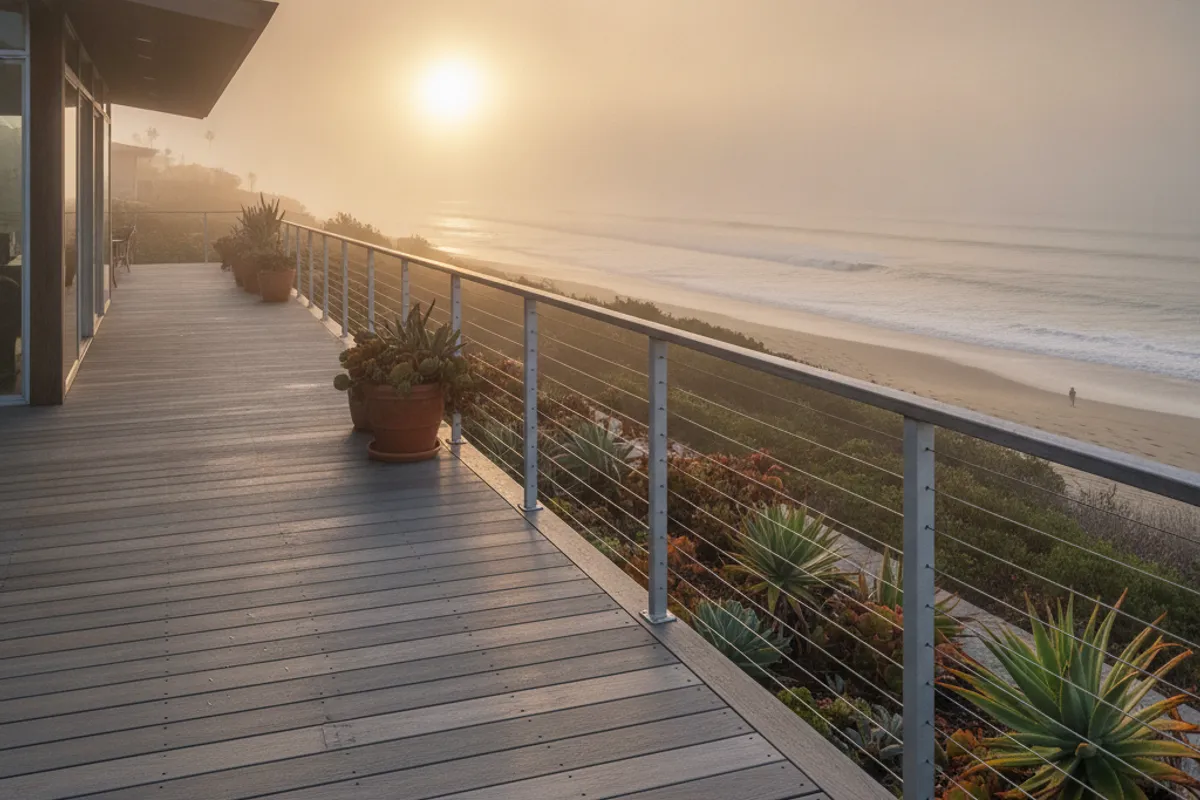
Salt air is not a small variable
A deck in Escondido and a deck two blocks from the water in Encinitas are living in fundamentally different environments. The salt air and daily marine layer that defines San Diego’s coastal strip - from Oceanside in the north down through Imperial Beach - accelerates corrosion, dries out wood fibers faster than inland UV alone, and leaves mineral deposits on surfaces that trap moisture against the material. Choosing the wrong deck material or hardware for a coastal site means replacing boards or fasteners years earlier than you should have to.
This guide covers what actually works within a few miles of the San Diego coastline, and what to reconsider if your home is in Carlsbad, Del Mar, La Jolla, Ocean Beach, Coronado, or anywhere else where the morning air smells like the ocean.
Why the coastal environment stresses deck materials
Salt air carries sodium chloride and other mineral compounds in suspension. When sea spray or marine layer moisture settles on a deck surface, those compounds concentrate as the moisture evaporates. Over time, this degrades:
- Unsealed wood by penetrating the grain and cycling between wet and dry, which opens cracks and invites rot
- Metal fasteners and connectors through electrochemical corrosion that can work through zinc coating faster than it would inland
- Painted or stained surfaces by lifting and blistering from the constant moisture cycling
The marine layer also adds a daily moisture load that inland sites don’t see. Coastal San Diego communities get condensation on horizontal surfaces most summer mornings even without rain. A deck board sitting in that daily wet-dry cycle needs to be chosen accordingly.
Material by material: how they perform near the coast
Composite decking (capped)
Capped composite boards are the most coast-appropriate decking material for most residential projects. The plastic cap layer - high-density polyethylene on Trex Transcend, PVC on TimberTech Azek and other all-PVC products - does not absorb water. Salt air lands on it, rinses off with the next rain or a hose, and leaves no lasting damage to the board itself.
Capped composite also does not crack, split, or warp from the moisture cycling that stresses wood. The fasteners are the weak point on any composite install, not the boards themselves, which brings us to hardware.
For coastal projects, specify stainless steel or hot-dipped galvanized fasteners throughout - not standard zinc-plated screws. The price difference is real but modest compared to the corrosion issues that show up in 5-7 years with inadequate hardware on a salt-air site.
PVC decking
All-PVC decking (TimberTech Azek, WOLF, CPVC-core boards) is the most technically resistant material for coastal applications. Because there’s no wood fiber content, there’s nothing for moisture to degrade. It carries the highest upfront cost in the decking category but genuinely earns its premium within a mile or two of the water.
Weight and temperature expansion are the practical considerations. PVC boards expand and contract more with temperature swings than composite, which matters in hidden fastener systems where spacing tolerance is tighter. Your installer needs to account for this at installation.
Redwood
Redwood is the traditional California coastal deck material, and it still earns that reputation when properly maintained. The heartwood contains tannins and oils that naturally resist moisture and insects without chemical treatment. A well-maintained redwood deck in La Jolla or Coronado can last 25-30 years.
The maintenance commitment is real: annual cleaning plus resealing or restaining every 2-3 years at minimum, and inspection for board wear after any significant storm. Coastal sun and salt air together accelerate the degradation of any surface coating, so the maintenance interval is shorter than it would be inland.
Redwood also warrants stainless steel fasteners. Standard galvanized screws in direct contact with redwood’s tannins can accelerate corrosion through a galvanic reaction.
Cedar
Cedar performs similarly to redwood in coastal conditions - the natural oils provide some moisture resistance, and it accepts stain well. It’s less available in Southern California than redwood and tends to be comparable or slightly less expensive. If your contractor sources quality western red cedar, it’s a viable coastal choice with the same maintenance requirements as redwood.
Pressure-treated pine
Pressure-treated pine works structurally in coastal conditions - the preservative treatment is designed for ground contact and moisture exposure, which is why it’s used for framing and joists everywhere including coastal sites. As a decking surface, the visual quality is lower and the maintenance requirement is the same as or higher than redwood without the natural durability advantages. It’s not the first choice for coastal deck surfaces, though it’s completely appropriate for the substructure.
Hardwoods (Ipe, Teak, Cumaru)
Tropical hardwoods are genuinely excellent in coastal conditions. Ipe is extremely dense, naturally resistant to moisture and insects, and used on commercial boardwalk applications precisely because it handles the coastal environment better than most materials. The cost is high, the sourcing requires attention to FSC certification for responsible forestry, and the boards require pre-drilling because the density will split screws. For a high-end coastal deck in Del Mar or Rancho Santa Fe, hardwood is worth exploring. For most San Diego residential budgets, capped composite or redwood is the practical answer.
Hardware and connectors near the coast
Whatever decking you choose, specify stainless steel (316 grade for within a mile of the water, 304 grade for 1-3 miles inland) or hot-dipped galvanized hardware throughout. This applies to:
- Deck screws and hidden fastener clips
- Joist hanger connectors
- Post base hardware
- Railing post mounts
Standard galvanized and zinc-plated hardware will corrode on a coastal site in 5-10 years. The cost premium for stainless steel is typically $200-$600 on a mid-size deck. Worth it every time.
Recommendations by proximity to the coast
Within 1 mile of the water (beach communities, bay-adjacent homes): Capped composite or all-PVC decking with 316 stainless hardware. Redwood is viable with rigorous maintenance commitment. Avoid pressure-treated pine as a surface material.
1-3 miles from the coast: Capped composite is the low-maintenance first choice. Redwood or cedar with good maintenance is a solid option. Hardware spec stays at minimum hot-dipped galvanized.
3+ miles inland (central and east county communities): All materials perform adequately. Coastal-specific concerns drop significantly. See the composite vs wood decking guide for the inland decision framework.
For a look at the full range of decking materials and how they compare in different San Diego climate zones, the deck materials and construction guide covers the structural side of the equation.
The practical answer for most coastal homeowners
For a homeowner in Carlsbad, Cardiff, La Jolla, or Coronado who wants a deck that holds up in the coastal environment without an ongoing maintenance project, capped composite with stainless steel hardware is the honest answer. It’s not the cheapest option upfront, but it’s the one that performs in the salt air and marine layer without demanding your attention every year.
Call (858) 400-4918 to get connected with a local deck crew that has real experience with coastal San Diego conditions and can specify the right material and hardware for your site.
What deck material holds up best to salt air in San Diego?
Capped composite and all-PVC decking hold up best against salt air and marine layer moisture because they don’t absorb water. Among wood options, redwood outperforms pine in coastal conditions because of its natural tannin content and moisture resistance.
Do I need special fasteners for a coastal deck in San Diego?
Yes. Within 1-3 miles of the coast, specify 316 or 304 stainless steel screws and connectors. Standard zinc-plated and even hot-dipped galvanized hardware will corrode faster on a salt-air site. The premium is modest relative to the labor cost of replacing corroded hardware later.