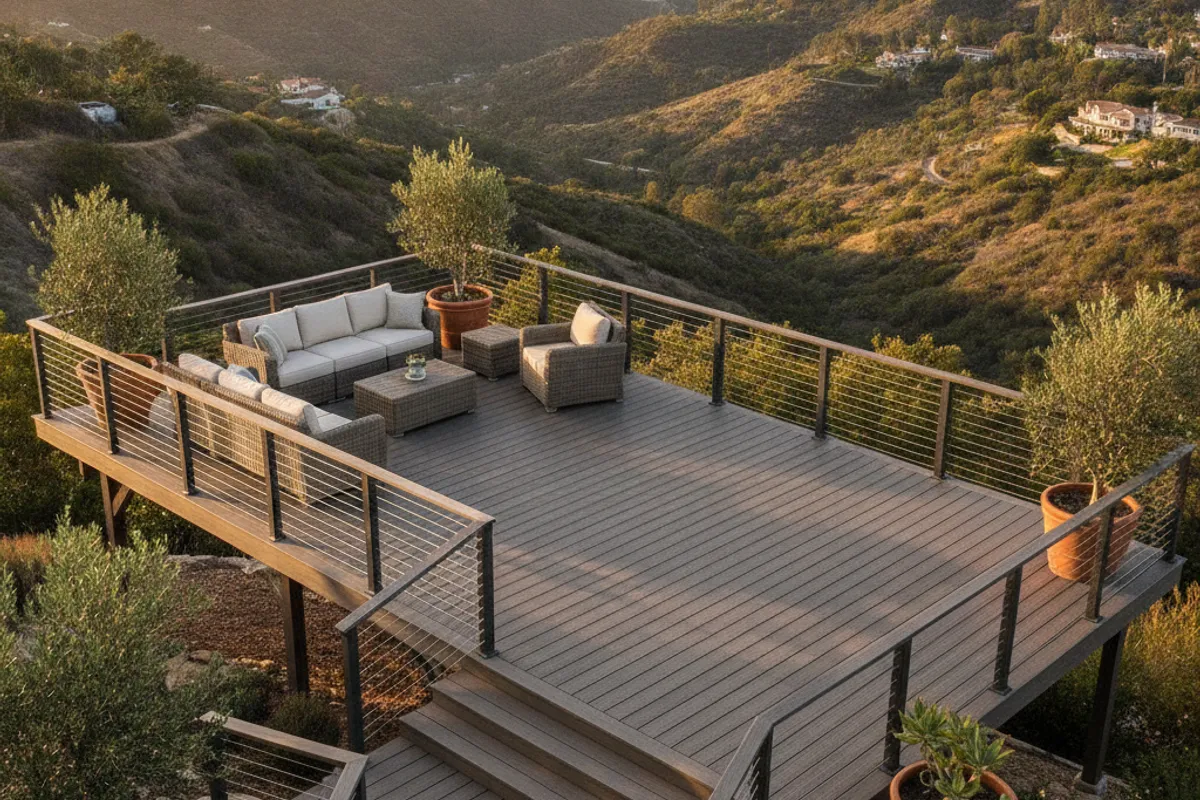
Multi-level decks solve a San Diego-specific problem
San Diego’s topography creates a common backyard scenario: the house sits at one elevation, the usable yard area is a few feet lower, and the transition between them is either a concrete step or a dirt slope that’s not particularly useful to anyone. A multi-level deck turns that transition into the feature rather than the problem.
A well-designed multi-level deck in places like Tierrasanta, Mission Hills, Clairemont, or any of the foothill communities converts a grade change into a series of connected outdoor spaces - a dining area at the house level, a sitting area at the intermediate level, a ground-level transition to the yard, or a view platform on a hillside lot.
This guide covers what multi-level decks involve, what makes them work well, and what they cost in San Diego.
When a multi-level design makes sense
Multi-level deck design adds cost and complexity over a single-level build. It makes sense when:
The lot has a natural grade change. A flat lot can support multiple deck levels, but the design case is weaker because there’s no terrain to work with. Flat lots are almost always better served by a single larger platform than by multiple smaller platforms at the same elevation.
Different activity zones benefit from different heights. A dining area close to the house at the same level as the interior floor creates a natural indoor-outdoor flow. A lower seating area - with different sight lines, perhaps more sheltered from the afternoon wind coming off the water in coastal communities - provides a different experience. The levels create distinct spaces without walls.
Access to a lower yard requires traversal. If the usable yard is 4-6 feet below the house level, stairs down a bare slope are awkward. A multi-level deck with integrated stairs provides a graceful, code-compliant path and adds usable platform space on the way down.
A view dictates the platform height. On a hillside lot in Tierrasanta or Alpine, the best view might be from a specific elevation that’s neither the house floor level nor the ground. A cantilevered or elevated platform at that height, connected to the house by a secondary level, captures the view without requiring an elevator.
Structural considerations for multi-level builds
Each deck level in a multi-level system has its own framing - its own posts and footings, its own beam and joist system. The levels are connected by stairs and sometimes by shared structural elements, but they’re essentially independent structures that happen to be adjacent.
This has two implications:
Permitting: Each level may trigger its own permit requirements depending on height above grade, attachment to the house, and area. A multi-level deck with any platform over 30 inches above grade needs a guard (railing) system. A multi-level deck with any platform at a different height than the house floor typically requires stairs with specific tread and riser dimensions.
Footing loads: On a hillside site, the lower deck level’s footings are carrying their load at a different elevation than the upper level. The soil bearing at different depths on a slope may vary. This is part of why hillside multi-level builds more commonly require engineered drawings.
For properties in areas with complex slope conditions - canyons in Mission Hills or Clairemont, ridge-top lots in Alpine or Ramona - a structural engineer’s involvement in the design is worth having even when the jurisdiction doesn’t strictly require it. The investment in proper engineering is small relative to the cost of a structural problem discovered during framing.
Stair code requirements for multi-level decks
Stairs connecting deck levels must comply with California Residential Code requirements:
- Maximum riser height: 7.75 inches
- Minimum tread depth: 10 inches (measured nose to nose)
- Minimum stair width: 36 inches
- Handrail requirement: Required on any stair with 4 or more risers; 34-38 inches high measured from the stair nose; must be graspable (specific size requirements for the rail profile)
These numbers apply to the stairs between deck levels and from the deck to grade. Getting stair dimensions right matters both for code compliance and for comfortable daily use. A stair with 7-inch risers and 11-inch treads feels natural to walk. A stair that pushed the maximums feels steep and slightly off.
If the grade change between levels is large (more than 6-7 feet), a landing platform mid-stair may be required or strongly recommended for code and safety reasons. This adds a third intermediate level that functions both as a landing and as a transitional platform.
Design principles that make multi-level decks work
Establish a primary level. One level should be the main functional space - typically the level connected directly to the interior floor. Size it to accommodate the primary activity (dining table, furniture grouping) with comfortable circulation around it.
Secondary levels have smaller footprints. A 300 sq ft primary level with a 150 sq ft secondary level works. Two identical large platforms look repetitive and miss the point of multi-level design.
Lighting at every level transition. Step lights, deck lighting in the stair risers, and lighting at each platform perimeter make a multi-level deck functional at night and prevent the stair transitions from being hazards after dark. Integrated lighting is far easier to do during construction than to retrofit afterward.
Railing continuity. The railing system should read as a continuous design element across levels, even when the individual sections are at different heights. Using the same post style and cap rail profile throughout creates visual coherence.
Pergola placement. If you’re considering a pergola or shade structure, the primary level or the level most used during the afternoon is usually the right location. A pergola on a secondary lower level often feels displaced from the main use space.
Cost ranges for multi-level decks in San Diego
Multi-level decks cost more than equivalent single-level area for two reasons: the additional framing complexity at transitions, and the integrated stair systems between levels.
- Basic two-level composite deck with stairs (total 400-500 sq ft): $28,000-$45,000
- Multi-level deck with pergola and integrated lighting (500-700 sq ft total): $40,000-$70,000
- Complex hillside multi-level with significant framing (engineer required): $55,000-$90,000
These are San Diego County ranges. Actual cost depends on specific level elevations, slope of the site, material choice, and whether any portion of the build requires engineered drawings.
For a view of all the factors affecting deck construction cost in San Diego, and to understand the permit process for a project with multiple deck levels, those guides have the detail.
Call (858) 400-4918 to connect with an insured local deck crew that can walk your property and give you a realistic design and cost picture.
How much does a multi-level deck cost in San Diego?
A two-level composite deck with stairs in San Diego typically runs $28,000-$45,000 for a combined 400-500 sq ft. More complex hillside builds with significant framing requirements and engineering run $55,000-$90,000.
Do multi-level decks need permits in San Diego?
Yes. Any portion of a multi-level deck over 30 inches above grade requires a building permit and railing system. Decks over 30 inches above grade in most San Diego jurisdictions also require engineered structural drawings. The permit process is similar to a single-level deck - the complexity is in the drawings, not the approval process.
What is the minimum stair width between deck levels?
California Residential Code requires a minimum 36-inch stair width between deck levels. Maximum riser height is 7.75 inches; minimum tread depth is 10 inches. A handrail is required for any stair with 4 or more risers.