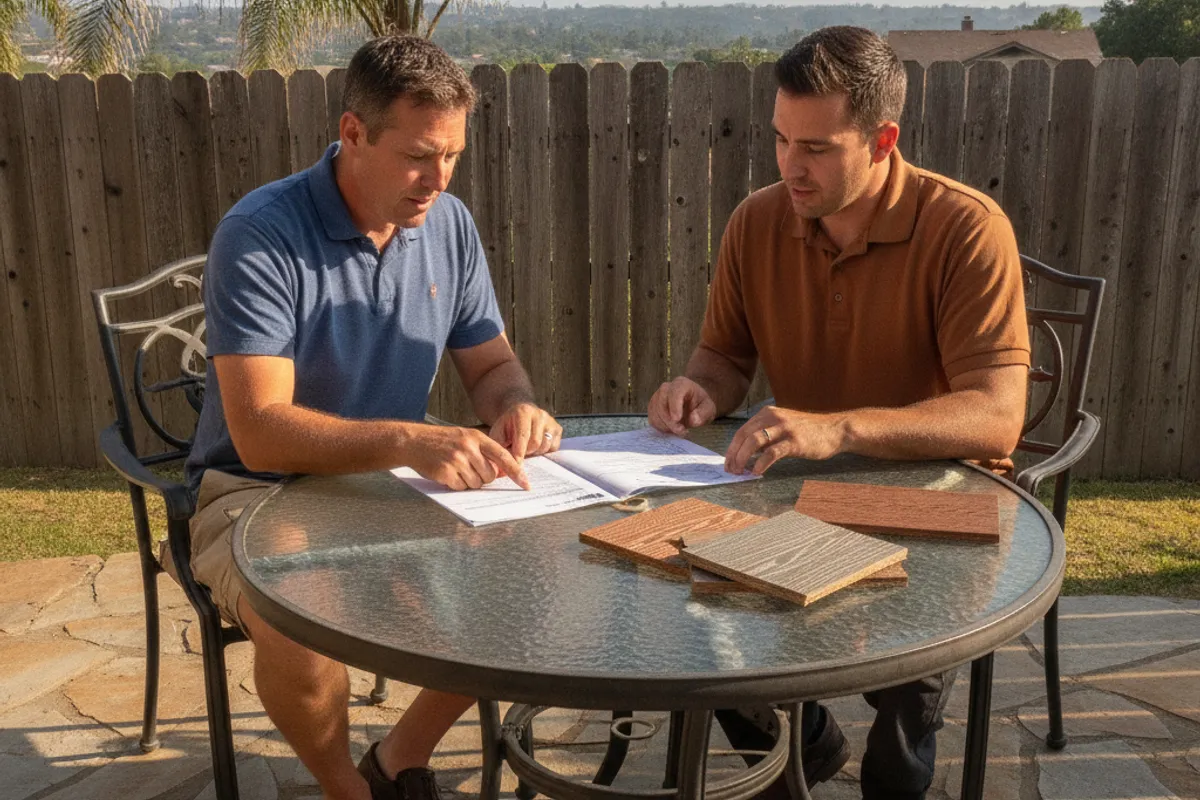
Ask for the contractor license number first, then check it on the CSLB public lookup before you compare quotes. San Diego has a dense construction market. Deck work attracts licensed builders and unlicensed quotes. The gap in liability and outcome is real. Deck Pro SD is a referral match. You contract and pay the builder directly. Call (858) 400-4918.
There is no shortage of people willing to build your deck
San Diego has a dense construction labor market, and deck projects attract everyone from licensed general contractors with decades of experience to unlicensed handymen quoting half the price. The gap in quality, liability, and outcome between those two ends of the market is significant.
Getting the right person for the project is not complicated, but it requires doing a few specific things that most homeowners skip. Here’s what actually matters.
Start with the license check
California requires a contractor’s license for any project valued at $500 or more in labor and materials. Deck construction falls under this threshold immediately.
The relevant license types for deck work:
- B - General Building Contractor: Can handle the full scope of a deck project including framing, decking, and railings.
- C-5 - Framing and Rough Carpentry: The specialty license that covers structural framing work.
- C-27 - Landscaping: Can include deck and hardscape construction within the landscaping scope.
Any of these licenses is appropriate for deck work. What matters is that the license is active and the contractor is in good standing.
The CSLB (Contractors State License Board) makes this easy to verify. Go to cslb.ca.gov, search by license number or business name, and you’ll see:
- License status (active, expired, suspended)
- License classification
- Expiration date
- Workers’ compensation coverage
- Any disciplinary actions or complaints
Do this before you have a first meeting. If a contractor can’t give you a license number, that’s a complete stopping point.
Verify insurance: workers’ comp specifically
Homeowners are frequently unaware of the liability exposure from hiring an uninsured contractor. If a worker is injured on your property and the contractor doesn’t carry workers’ compensation insurance, the injured party can potentially come after your homeowner’s insurance - or you personally. This is not a theoretical risk.
California law requires contractors who have employees to carry workers’ compensation. The CSLB check shows workers’ compensation status. For larger projects, asking for a certificate of insurance directly from the contractor’s insurance provider is also appropriate.
General liability insurance protects you if the crew damages your property during the build. Both types of insurance matter.
What to look for in a quote
Get at least three written quotes from contractors whose license you’ve verified at cslb.ca.gov. Verbal quotes don’t hold up. A professional quote should include:
- Specific product names and SKUs - not “composite decking” but “Trex Transcend Havana Gold” or “TimberTech Azek Arbor Collection, Weathered Teak”
- Substructure specifications - post size, species, beam dimensions, joist spacing
- Hardware specification - fastener type and brand, joist hanger model
- Whether the permit is included - who pulls it, and whether the fee is in the quote
- Payment schedule - how much upfront, when progress payments are due, retention at final inspection
- Start and completion timeline with any dependencies (permit issuance) noted
The cheapest quote is frequently cheap because it omits one of these line items. A missing permit, a vague substructure spec, or unlisted hardware can represent thousands of dollars of scope that shows up as a change order later.
Questions to ask every bidder
“Can you give me the license number so I can verify it before we meet?” - A professional contractor will have no hesitation about this. It signals that you’re going to treat this project seriously.
“Who pulls the permit?” - The contractor should pull the permit in their own name. A contractor who asks the homeowner to pull the permit is transferring liability inappropriately.
“Will you use a subcontractor for any portion of the work, and if so, are they licensed?” - Subcontracting is normal on larger projects. You want to know whether the person on your project is the same person who gave you the quote.
“Can you show me a project similar to mine that I can look at?” - For elevated or hillside decks, or for any project with significant complexity, seeing completed work in San Diego is more informative than a portfolio of photos. Some contractors are happy to connect you with past clients.
“What’s your warranty on the installation?” - Separate from the manufacturer’s warranty on the decking boards, the contractor should stand behind their own workmanship. One to two years is typical for installation defects.
Red flags worth taking seriously
No license number offered or verifiable. Non-negotiable. Walk away.
Demand for large upfront payment. California law limits contractor down payments to 10% of the contract price or $1,000, whichever is less. Contractors who demand 40-50% upfront before starting have no legal basis for it and it’s a risk indicator.
Quote significantly lower than all others. This almost always means something is missing from the scope, the contractor will cut corners on materials, or they don’t intend to pull permits. A 20% price difference is worth asking about. A 50% difference is a red flag.
Pressure to sign quickly or “lock in the price today.” A professional contractor is not running a time-share sales pitch. Take the time you need to compare quotes.
Unable to provide a real business address. Some operators work from a P.O. Box or with no fixed address. Not automatically disqualifying, but check the CSLB registration address and look for online reviews that describe the business with some stability.
How Deck Pro SD connects homeowners with crews
Deck Pro SD is a referral service. When you call (858) 400-4918, we connect you with insured local deck crews serving San Diego County - crews we vet for license status and general reputation. You still get your own quote directly from the crew, and we encourage you to verify their credentials at cslb.ca.gov and compare their quote alongside others.
The value is in having a starting point with a crew that has been screened, rather than cold-calling from a general list. The final hiring decision is yours, as it should be.
For background on what a deck construction project involves from a scope standpoint, and for detail on the permit process in San Diego, those guides give you the context to have a more informed conversation with any contractor you meet.
What license does a deck builder need in San Diego?
A B (General Building), C-5 (Framing and Rough Carpentry), or C-27 (Landscaping) license is appropriate for residential deck construction in California. Verify any contractor’s license status at cslb.ca.gov before hiring.
How much should a deck builder ask for upfront in California?
California law limits contractor down payments to 10% of the contract price or $1,000, whichever is less. Contractors who demand large upfront payments before starting work are operating outside this limit and it’s a warning sign.
How do I verify a deck contractor is licensed in San Diego?
Go to cslb.ca.gov and search by license number or business name. The lookup shows license status, expiration, workers’ compensation coverage, and any disciplinary history. Do this before signing any contract.