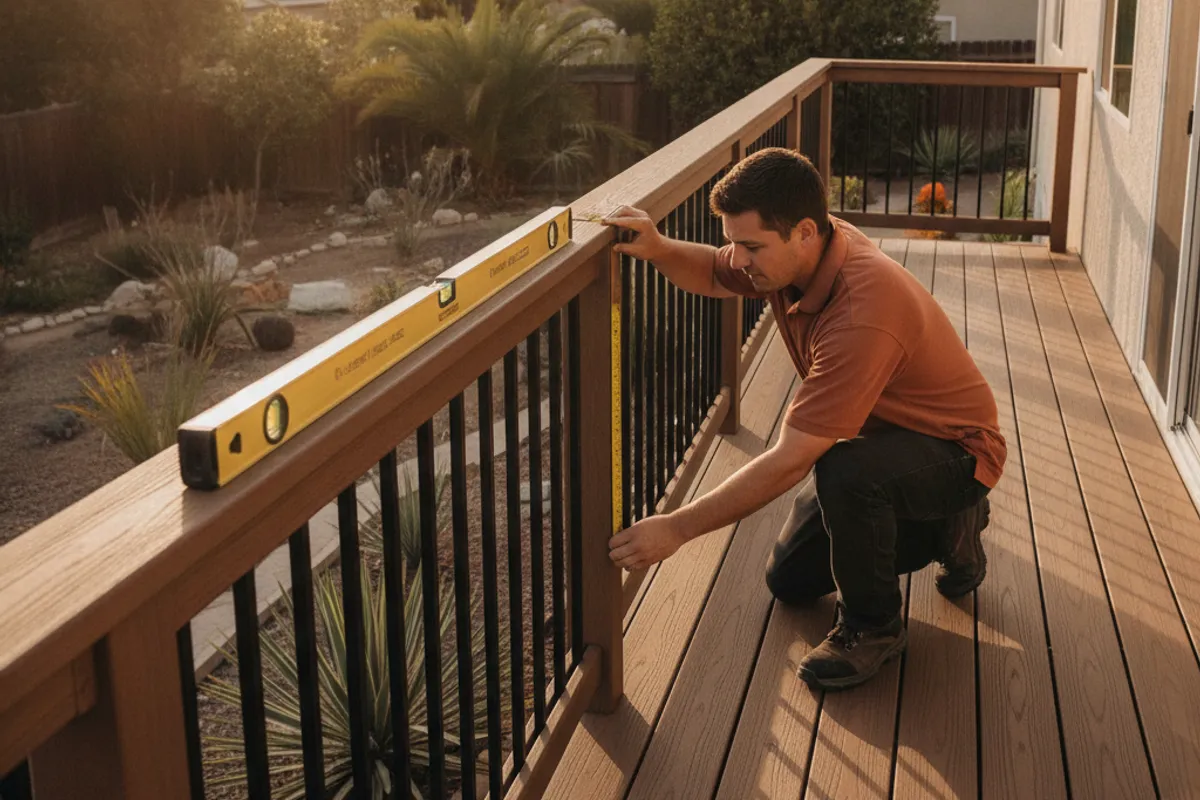
Deck railings are structural elements, not decoration
Most homeowners think about railing as an aesthetic choice - what style, what material, what color. All of those questions matter, but they come after the structural and code questions that determine what railing system is even legal on your deck.
California builds on the International Residential Code (IRC) with state amendments, and local San Diego jurisdictions add their own requirements. The core railing rules are consistent across most of the county, with some variation in permit processing between the City of San Diego, unincorporated county, and the incorporated cities like Chula Vista, Carlsbad, El Cajon, and Escondido.
Here’s what the code says and what your options are.
When railings are required
A railing (the code calls it a “guard”) is required on any deck surface that is 30 inches or more above the adjacent finished grade. This is a hard threshold - a deck that’s 29 inches above grade does not legally require a guard, while one that’s 31 inches does.
In practice, most elevated decks in San Diego are significantly above 30 inches, so the question of whether you need a railing rarely comes up. The questions that come up more often are about height, spacing, and structural requirements.
Railing height requirements
The California Residential Code (CRC) requires guards to be at least:
- 36 inches high for residential decks where the deck surface is less than 30 feet above grade (which covers nearly all single-family home decks)
- 42 inches high where the walking surface is 30 feet or more above grade (applies to some second-story or elevated hillside decks)
Height is measured from the deck surface to the top of the rail. A railing that looks tall can still fail inspection if it doesn’t meet the minimum measurement.
Stairs are a separate issue. Stair railings (handrails) have their own requirements for height (34-38 inches measured from the stair nose), graspability, and extensions at the top and bottom of the run.
Baluster spacing
The opening between balusters, spindles, or other infill elements cannot allow a 4-inch sphere to pass through. This is the “4-inch sphere rule” and it exists because a child’s head fits through openings larger than 4 inches.
The 4-inch spacing rule applies to the spaces between vertical balusters in traditional railing systems. It also governs the opening at the bottom of the rail, between the deck surface and the bottom rail. An opening larger than 4 inches at the bottom of a railing fails code even if the balusters themselves are spaced correctly.
For stair railing infill, the sphere test uses a different size in some versions of the code - confirm with your local building department or contractor.
Post strength requirements
This is the code requirement that affects your railing system design most significantly and that homeowners least often know about. The CRC requires that guards be designed to resist a concentrated load of 200 pounds applied at any point at the top of the rail, and an inward or outward lateral load of 50 pounds per linear foot.
What this means in practice: the railing posts - whether wood, steel, or aluminum - must be anchored to the deck framing in a way that resists significant force without the top of the rail deflecting more than allowed. A post that’s simply screwed to the face of a joist does not typically meet this requirement. Posts need to be either:
- Through-bolted to the deck framing with appropriate lag screws or carriage bolts and bearing against the framing in compression
- Surface-mounted with hardware specifically tested and rated for the post size and height being used (many aluminum railing systems use tested surface-mount post bases with published load ratings)
- Inset-mounted into the deck framing with a post collar or blocking detail
If you’re replacing an existing railing, check how the existing posts are attached before assuming the existing mounting detail is code-compliant. Many older decks have railing posts attached in ways that made visual sense but don’t meet current load requirements.
Railing material options
Wood
Pressure-treated lumber, redwood, and cedar all work for railing posts, top rails, and balusters. Wood railing looks natural and integrates well with wood deck surfaces. The maintenance requirements are the same as the deck surface - regular cleaning and sealing to prevent cracking and splitting.
For coastal San Diego applications, redwood or cedar hold up better near salt air than pine because of natural moisture resistance. In all cases, hardware connecting wood railing components should be hot-dipped galvanized or stainless steel.
Aluminum
Aluminum railing systems are the dominant choice for composite and PVC deck builds in San Diego. They’re maintenance-free, corrosion-resistant (important near the coast), and available in a wide range of profiles and colors. Most major composite deck manufacturers (Trex, TimberTech) offer matching aluminum railing systems.
Aluminum systems also come as tested assemblies with published load ratings, which simplifies the structural compliance question. When the railing manufacturer provides a load-rated post base and the system is installed per the manufacturer’s installation guide, the code compliance burden shifts to the manufacturer’s data.
Cable railing
Cable railing - stainless steel cables tensioned between posts - has become popular in San Diego for decks with views (hillside homes, properties in Tierrasanta, canyon-adjacent neighborhoods, coastal bluffs). The cables maintain sight lines in a way that balusters don’t.
The code compliance nuance with cable railing is the sphere test. Horizontal cable runs can allow a 4-inch sphere to pass between cables if they’re not tensioned correctly or if the cable spacing was specified incorrectly. Cable tension also matters - cables must be tensioned to specified minimums or they deflect too much under load and can become climbable. Any cable railing system needs to be installed by a contractor who understands the engineering requirements.
Glass railing
Glass panels (tempered safety glass or laminated glass, never standard float glass) provide the maximum view without visual obstruction. Common in La Jolla, Del Mar, and other coastal premium properties.
Glass railing panels must be supported by structural posts and appropriate hardware. Point-fixed glass systems (where the glass is drilled and mounted at discrete points) are common. Framed glass systems (where the glass sits in a channel frame) are also used. Both approaches require the glass specification to account for wind loads, which can be significant on elevated or coastal sites.
For the complete picture of deck construction and the permit and inspection process in San Diego, those guides cover the full project scope.
Call (858) 400-4918 to connect with an insured local deck crew that handles railing specification and installation across San Diego County.
How high does a deck railing need to be in San Diego?
36 inches is the minimum height for a residential deck guard in California when the deck surface is less than 30 feet above grade. 42 inches is required at 30 feet above grade and higher.
How far apart can deck balusters be in San Diego?
Baluster spacing cannot allow a 4-inch sphere to pass through - this means approximately 3.5 inches of clear space between balusters. The same 4-inch sphere rule applies to the opening at the bottom of the railing above the deck surface.
Is cable railing allowed on San Diego decks?
Yes, cable railing is allowed and commonly used. The cables must be spaced and tensioned correctly to meet the 4-inch sphere test and structural load requirements. A contractor experienced with cable railing systems will design the cable spacing and tension specification correctly.