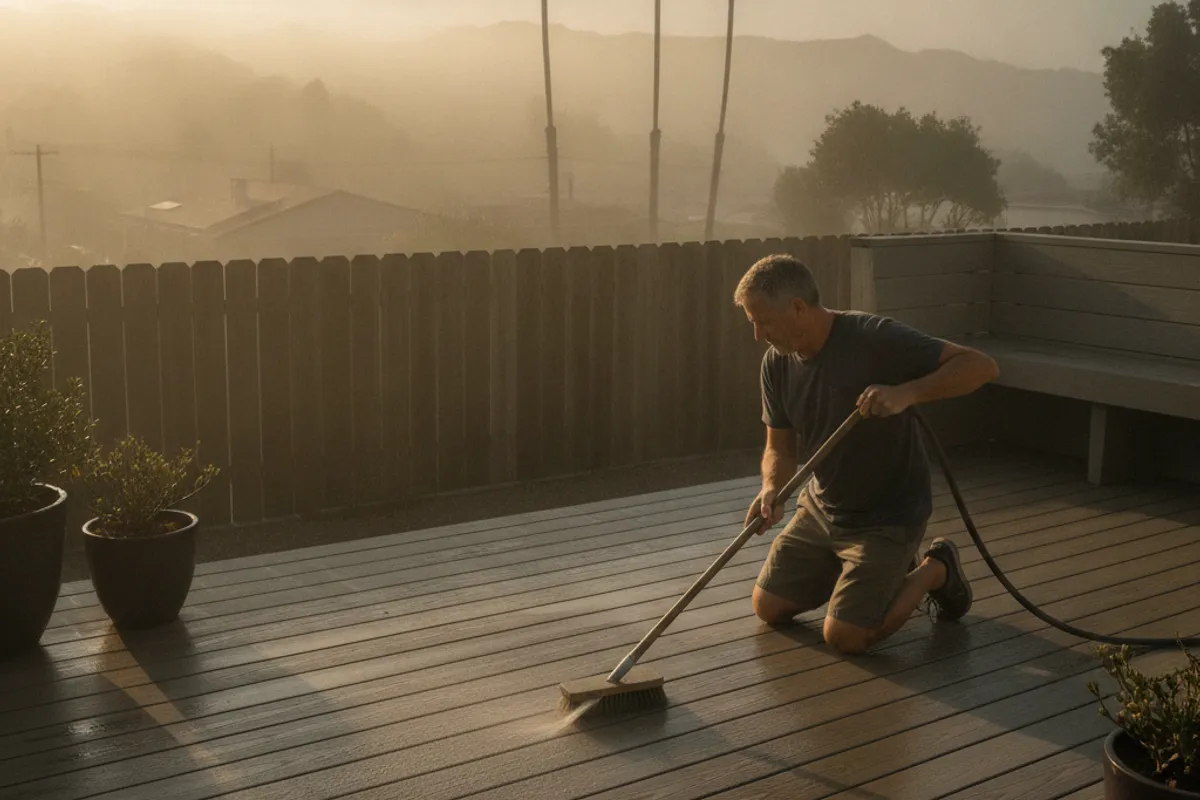
The marine layer changes the maintenance math
Most deck care advice is written for climates with clear seasonal patterns - a wet spring, a dry summer, a wet fall. San Diego doesn’t work that way. The marine layer - that low coastal cloud and fog that settles over the county most summer mornings from June through August - creates a daily moisture cycle that doesn’t show up on any rainfall chart but absolutely shows up on deck surfaces.
A wood deck in Carlsbad or Del Mar is getting wet every morning during June Gloom, even without a drop of measurable rain. That moisture sits on the surface until the cloud burns off, then the board dries rapidly in the afternoon sun. Repeat 60-70 times over June, July, and August, and the daily wet-dry cycling accumulates real stress on unprotected wood grain.
Understanding this is the starting point for maintaining a deck in San Diego correctly.
Wood deck maintenance: what the schedule looks like
Annual cleaning
Every wood deck - whether pressure-treated pine, redwood, or cedar - needs an annual cleaning that does more than hose off loose debris. A proper clean involves:
- Sweeping the deck surface, including between boards, to remove leaves, dirt, and organic matter
- Washing with a deck cleaner appropriate for your wood type (follow the manufacturer’s dilution for your product - too strong damages wood fibers)
- Rinsing thoroughly and allowing 48-72 hours of dry time before applying any sealer
If there’s mold or mildew on the surface - common on shaded coastal decks in Encinitas, Pacific Beach, or Ocean Beach - use a cleaner with an appropriate biocide component. Mildew on a deck surface indicates the boards are staying wet longer than they should be. Check that there’s nothing blocking airflow underneath (accumulated leaves, debris) and that the deck boards have appropriate gaps for drainage.
Sealing and staining timeline
How often you need to reseal depends on your location in the county, sun exposure, and what’s on the deck now.
- Coastal communities (Carlsbad, Cardiff, La Jolla, Ocean Beach, Coronado): Reseal every 1-2 years. The daily marine layer moisture and any salt air component accelerate the breakdown of surface coatings.
- Central inland (Santee, La Mesa, Mission Valley, Kearny Mesa): Reseal every 2-3 years. More sun, less humidity. South and west-facing surfaces need attention sooner.
- North County inland and east county (Escondido, Ramona, Alpine): Every 2-3 years, with south-facing surfaces more often. High UV load in these areas.
The test: sprinkle water on the deck surface. If it beads up, the sealer is still working. If it soaks in immediately, you’re due. Don’t wait until the wood looks gray and dry - resealing depleted wood is harder than maintaining a surface that still has some protection.
Product selection: sealers vs. stains
Penetrating oil sealers (products that absorb into the wood rather than sitting on top) work better on redwood and cedar than film-forming sealers. Film-forming products can peel and require more aggressive prep when it’s time to reapply. Semi-transparent stains protect the wood and add color while still letting the grain show.
For coastal decks in San Diego, look for products that specifically include mildewcides. The brands that sell locally at San Diego building supply stores are generally formulated for California climates - ask the staff what they recommend for coastal use.
Board inspection: what to look for each year
During your annual cleaning, look for:
- Boards with raised grain or checking (small cracks along the grain): Normal weathering. Seal promptly to prevent the cracks from deepening.
- Soft spots or discoloration: Probe with a screwdriver. If the wood feels soft, there may be rot beginning. This is repairable if caught early, expensive if not.
- Fasteners backing out: Deck screws back out over time from seasonal movement. Reset them. A popped screw is a splinter hazard and eventually a structural concern.
- Ledger area: The connection between the deck and the house is the most water-sensitive area. Check that the flashing is intact and there’s no water intrusion behind the ledger board.
Composite deck maintenance: much simpler, not zero
Composite and PVC decks in San Diego don’t need sealing or staining. The maintenance routine is simpler but not completely absent.
Cleaning schedule
An annual wash with a mild soap solution and a soft-bristle brush handles most composite decks in San Diego. In coastal communities where the marine layer deposits mineral residue, or on decks under trees where organic debris sits, twice-yearly cleaning is reasonable.
Avoid pressure washers on composite at high pressure - they can damage the cap layer. Low-pressure washing (below 1,500 PSI) with a fan tip nozzle at least 8 inches from the surface is safe.
Mold and mildew on composite
Composite decks in shaded locations, especially in coastal San Diego where the marine layer keeps humidity high, can develop mold or mildew on the surface. This is a surface condition, not a structural problem - the cap layer prevents penetration. Clean with a composite deck cleaner that includes a mildewcide component, following manufacturer instructions for your specific product.
Improve drainage and airflow where possible if you’re seeing recurring mildew. Overhanging trees, enclosed undersides, and blocked drainage channels between boards all contribute.
Inspection points for composite
Check fasteners annually - hidden fasteners can back out or corrode over time, which is worth catching before a loose board becomes a trip hazard. Check the end grain of any boards that were cut during installation and weren’t sealed with a manufacturer-recommended end-sealer. Cut ends are the moisture vulnerability in capped composite.
Deck repair vs. full replacement
Deck maintenance leads eventually to a decision about whether to repair or replace. Key signals that it’s time to think seriously about replacement rather than more maintenance:
- More than 20-25% of the deck boards have visible rot or need replacement
- The substructure (joists, beams, posts) shows rot or deterioration
- The ledger connection to the house has been compromised
- The deck no longer meets current code requirements (railing height, footing depth)
A well-maintained wood deck in San Diego typically lasts 15-25 years before the cumulative maintenance cost and board condition suggest replacement makes more sense than repair. For a new deck construction estimate or a deck repair assessment, a local crew can walk the deck and give you a clear-eyed read.
Call (858) 400-4918 to get connected with an insured local deck crew serving San Diego County.
How often should I seal a wood deck in San Diego?
In coastal communities affected by the marine layer, seal every 1-2 years. Inland areas with more stable conditions can go 2-3 years. The water-bead test tells you when it’s time - if water soaks in instead of beading, reseal soon.
Does the marine layer damage composite decks?
Composite decks handle marine layer moisture well - the cap layer resists moisture penetration. The main effect in coastal areas is more frequent mildew growth on the surface, which is a cleaning issue, not a structural one.
How do I know when my deck needs to be replaced rather than repaired?
If more than 20-25% of the boards need replacement, or if the substructure (joists, beams, posts) shows rot, replacement typically makes more financial sense than repair. A local deck contractor can do a structural assessment to tell you which direction you’re in.