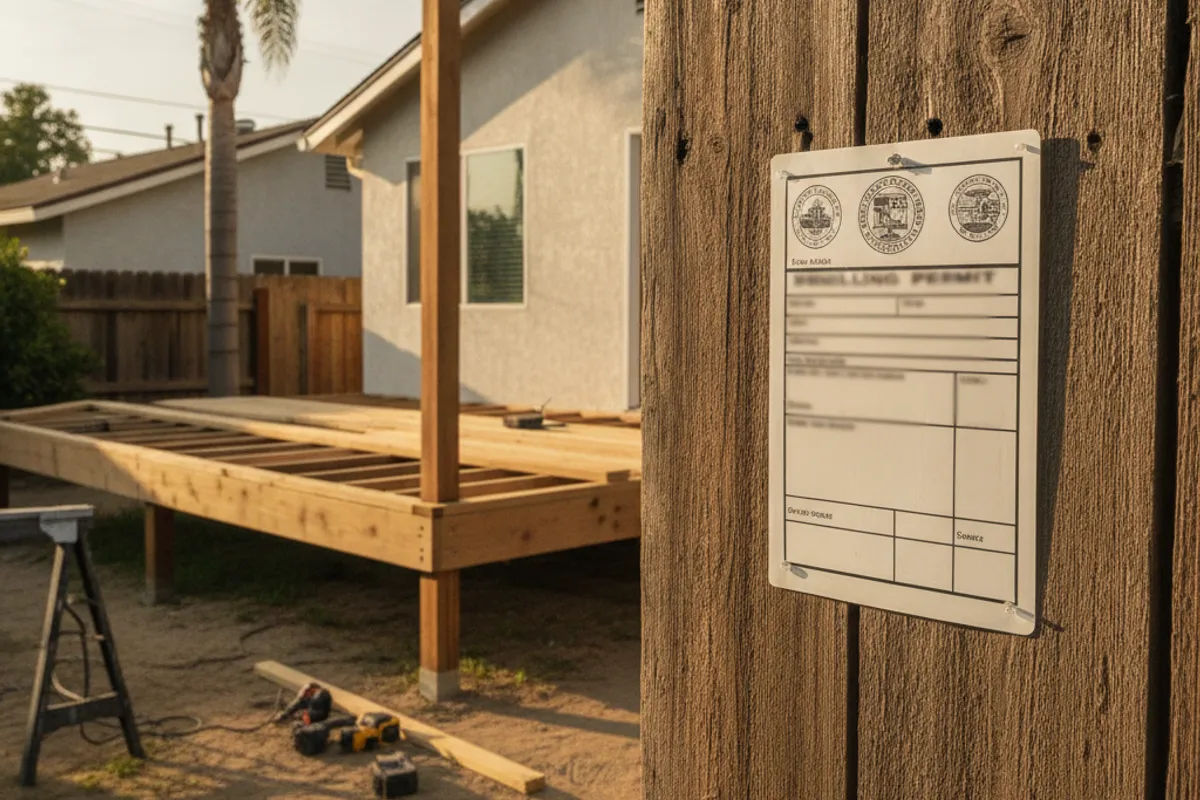
Permits matter more for decks than most homeowners expect
Decks occupy a specific regulatory space that catches a lot of San Diego homeowners off guard. They’re not just outdoor furniture you set out and take in - they’re permanent structures attached to or adjacent to your home, and they trigger building permits, structural inspection requirements, and setback rules that vary by city and by the height of the deck above grade.
Building without a permit creates a disclosure problem at resale and can require demolition or expensive after-the-fact permitting. Pulling the permit correctly from the start takes a few extra weeks but protects the investment.
When a permit is required
In San Diego County and all incorporated cities, a building permit is required for any deck that:
- Is attached to the house (ledger-attached deck)
- Has a finished surface more than 30 inches above the adjacent grade
- Has a total area over 200 square feet (threshold varies by jurisdiction)
- Includes electrical (lighting, outlets, hot tub hookup)
- Includes a covered structure (pergola, solid roof)
Freestanding ground-level decks under 200 square feet and under 30 inches above grade are the one category that sometimes qualifies as exempt, depending on the jurisdiction. Even then, HOA rules may require approval, and the City of San Diego has tighter thresholds than the county unincorporated area.
If you’re unsure, the conservative and correct answer is to pull the permit. The City of San Diego’s Development Services Department handles permits for properties in the city limits. Unincorporated county properties go through the County of San Diego Planning and Development Services. Cities like Chula Vista, La Mesa, Santee, El Cajon, Carlsbad, Escondido, and Oceanside each have their own building departments with their own fee schedules and processing timelines.
Setback requirements
Setbacks determine how close to your property line a deck can be built. San Diego residential zoning codes generally require:
- Rear yard setback: 5-10 feet from the property line (varies by zone)
- Side yard setback: 3-5 feet (varies by zone and lot width)
- Front yard setback: 20+ feet (most zones)
These are minimums for the deck structure itself. Railings and stairs may have their own setback provisions. If your lot is in a planned community, the CC&Rs may add more restrictive setbacks than the base zoning code.
Lots with easements - utility easements, drainage easements, sewer easements - cannot have permanent structures built over them. This is worth checking before designing the deck footprint, because a utility easement running behind your Kearny Mesa or Santee home could cut into what you thought was buildable yard.
Height restrictions
Most San Diego residential zones cap deck platforms at 30 inches above grade before railings are required. For platforms over 30 inches, code-compliant railings become mandatory (36 inches high for platforms up to 6 feet above grade, 42 inches high above that). There’s no hard height cap on the deck platform itself in most residential zones, but elevated decks require engineered drawings.
Homes in hillside or canyon-adjacent areas - common in areas like Tierrasanta, Mission Hills, Clairemont, and the canyon neighborhoods of North Park - sometimes have additional height and grading restrictions. The California Hillside Grading provisions in the county code apply to significant grading, and some hillside lots have deed restrictions on structure height.
Engineered drawings: when you need them
For decks over 30 inches above grade, most San Diego jurisdictions require structural drawings stamped by a licensed California structural or civil engineer. The engineer specifies footing depth, post size, beam span, and connection details. This adds $500-$1,500 to the project cost depending on the engineer and project complexity, and it adds time to the permit process.
Ground-level decks under 30 inches can often be permitted with a standard plan-check using prescriptive construction methods from the California Residential Code, without a site-specific engineer. Your contractor typically handles this.
The permit timeline across San Diego jurisdictions
Plan check processing time varies:
- City of San Diego: 4-8 weeks for over-the-counter review (standard projects); longer for projects requiring environmental review
- County unincorporated: 3-6 weeks for standard residential deck permits
- Carlsbad, Escondido, Chula Vista: 3-5 weeks typical
- La Mesa, Santee, El Cajon: 2-4 weeks for standard projects
Corrections on the plan check add another 1-3 weeks per round. A well-prepared set of drawings from an experienced local contractor or designer typically sails through in one round.
Some jurisdictions offer expedited review for an additional fee. If timeline is critical, ask your contractor about that option.
HOA approval: a separate process from city permits
If your home is in a planned community or an HOA-governed neighborhood - which covers a large share of homes in communities like Rancho Bernardo, Rancho Penasquitos, Carmel Valley, Otay Ranch, and San Marcos - you need HOA architectural committee approval before you can pull a city permit. The city won’t check for HOA approval, but your HOA CC&Rs may void your right to build without it, and you could face fines or forced removal.
HOA review timelines range from 2 weeks to 6 weeks depending on how frequently the architectural committee meets. Build this into your project schedule before you commit to a construction start date.
After the permit: what inspections happen
For an attached or elevated deck, inspections typically include:
- Footing inspection: before concrete is poured, to verify footing size, depth, and placement
- Framing inspection: after the substructure is up but before decking is laid, to verify post size, beam span, ledger connection, and joist hangers
- Final inspection: after the deck and railings are complete
Some jurisdictions combine framing and final. Your contractor coordinates with the building department to schedule inspections.
For deck construction specifics and what the substructure actually involves, see the deck construction guide. For detail on deck railing code requirements, see the deck railings guide.
What happens if you skip the permit
Unpermitted decks create problems at resale. California requires disclosure of unpermitted work, and buyers’ agents routinely flag it. Remediation options for an unpermitted deck include:
- After-the-fact permit (if the deck was built to code and can pass inspection)
- Demolition and rebuild to code (if it was built incorrectly)
- Price adjustment at sale to cover the buyer’s risk
The cost and complexity of after-the-fact permitting often exceeds what the permit would have cost in the first place, and some jurisdictions require demolition rather than after-the-fact approval. Don’t skip the permit.
You can verify any contractor’s license and check whether they carry active workers’ compensation at cslb.ca.gov. Deck contractors should carry a C-5 (framing) or C-27 (landscaping) license, or a general B contractor license, and should pull the permit in their own name.
Call (858) 400-4918 to get connected with a local deck crew that handles the permit process from start to finish, so you’re not navigating plan check on your own.
Do I need a permit for a small deck in San Diego?
Most decks in San Diego require a permit if they’re attached to the house, over 30 inches above grade, or over 200 square feet in area. Freestanding ground-level decks under these thresholds may be exempt depending on the jurisdiction, but the rules vary by city.
How long does a deck permit take in San Diego?
Plan check processing typically takes 3-8 weeks in San Diego County depending on the jurisdiction and whether corrections are needed. Add HOA review time on top of that if your home is in a governed community.
Who pulls the permit for a deck in San Diego?
The contractor should pull the permit in their own name. A contractor who asks the homeowner to pull the permit is shifting liability. Verify that your contractor is licensed and insured at cslb.ca.gov before signing a contract.