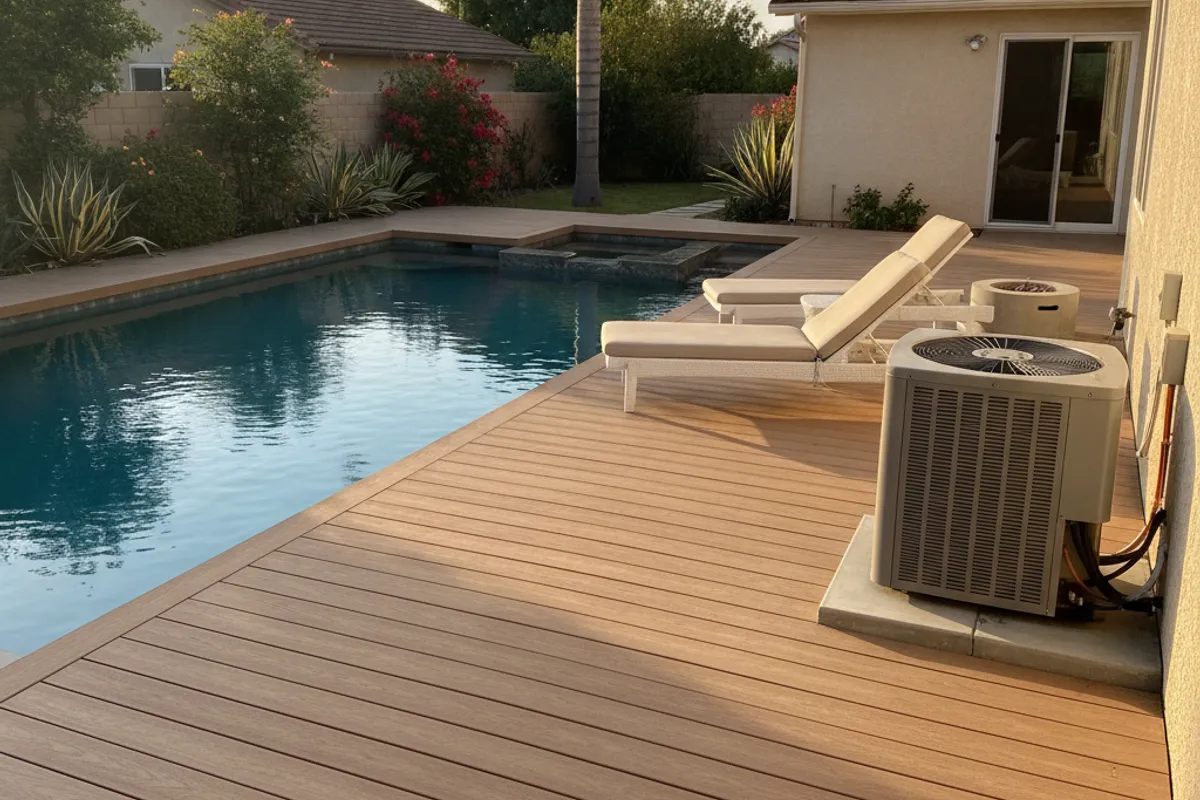
Pool decking is a different decision than backyard deck materials
The area around a pool has specific requirements that outdoor decks in other locations don’t: it gets wet constantly, it needs to be comfortable barefoot in San Diego’s summer heat, it needs enough texture to be safe when wet, and it takes direct chemical contact from pool water and splash. Most of the material conversations that apply to an elevated backyard deck apply differently here.
San Diego’s climate adds another layer. The inland heat in communities like El Cajon, Santee, and Escondido means a pool deck surface that’s hot in the summer is not just uncomfortable - it’s a reason people avoid using the pool in the middle of the day. Choosing materials with better solar reflectance matters.
Here’s how the main pool decking options compare for San Diego conditions.
Poured concrete: the standard and its variations
Poured concrete is the most common pool deck material in San Diego and across California. It’s durable, maintenance-minimal (compared to wood), and the blank slate for a range of finish options.
Broom-finished concrete: The basic option - brushed texture applied before curing gives non-slip texture, gray appearance. Most affordable. Functional but not particularly attractive. Works as a starting point.
Stamped concrete: Patterns pressed into wet concrete to mimic stone, tile, or paver appearances. Adds visual interest without the material cost of natural stone or pavers. Color is integral or applied with stain. The texture on stamped concrete should be specified carefully for a pool application - some stamp patterns are smooth enough to be slippery when wet. A light broom texture between the pattern edges is the safer approach.
Exposed aggregate: A different finish approach where the surface paste is washed away to expose the aggregate underneath - pebbles, river stone, or crushed stone. Creates a naturally textured, non-slip surface with visual depth. Popular in Poway, Rancho Bernardo, and other communities with a more natural landscape aesthetic. The texture is good underfoot but can be rough on tender feet if the aggregate is coarse.
Concrete pool deck cost in San Diego: $8-$20 per square foot installed depending on finish complexity, coloring, and site access. A 400 sq ft pool deck with broom finish runs $4,000-$7,000. Stamped concrete with custom coloring runs $12-$18 per square foot.
Pavers: the premium visual choice
Concrete pavers, travertine pavers, and other unit masonry products have become the preferred choice for higher-end pool areas in San Diego County. Communities like La Jolla, Carmel Valley, Del Mar, and Rancho Santa Fe see a high percentage of paver pool decks on new construction and renovation.
Concrete pavers: Manufactured units in a wide range of colors, textures, and formats. Non-slip surfaces are available. Easier to repair than poured concrete - if a section heaves or a paver cracks, individual units can be replaced without saw-cutting and patching a slab. Good mid-range option.
Travertine: Natural stone, typically tumbled or honed for a smooth but not polished surface. Travertine is lighter in color than most alternatives and runs significantly cooler underfoot in full sun than dark concrete or dark pavers. This matters in San Diego’s summer. A west-facing pool deck in Santee in August is noticeably cooler on travertine than on dark concrete. The trade-off: travertine is more porous than manufactured products and needs sealing every 2-3 years to prevent pool chemical staining.
Slate and bluestone: Natural stone options with good texture and a more refined appearance. Cost is higher than travertine. Less common in San Diego residential pool applications but appropriate for high-end projects.
Paver pool deck cost in San Diego: $15-$35 per square foot installed depending on material and complexity. Travertine typically runs $20-$30 per square foot installed for a pool deck application.
Composite decking around pools
Composite and PVC deck boards can be used in pool deck applications and are increasingly common in San Diego for homeowners who want a consistent look between a backyard deck and the pool surround. The advantages are real: no splinters, comfortable barefoot, and completely moisture-immune.
The considerations for pool applications specifically:
- Specify composite boards with a surface that’s non-slip when wet. Not all composite products have the same wet-surface traction. Check the manufacturer’s wet-friction specifications.
- Dark-colored composite boards get hot in full sun. In San Diego’s inland communities, specify lighter colors for pool-surround applications.
- Drainage design matters more around a pool. Board gaps must drain freely to prevent water accumulation under the deck and in the fastener channels.
- Pool chemicals in splash water will not damage composite or PVC boards, but check the manufacturer’s chemical resistance documentation for your specific product.
Composite pool deck cost in San Diego: $25-$45 per square foot installed for the deck surface, depending on board choice and substructure requirements.
What to avoid
Smooth hard surfaces: Glazed hard surfaces are popular around pools in Mediterranean climates, and they look great. Smooth glazed surfaces are dangerous when wet - period. If you want a hard surface near a pool, specify textured, non-slip materials and apply appropriate non-slip coatings. The right surface works. The wrong one is a liability.
Pressure-treated wood: Wood decking around a pool absorbs pool water, dries in the sun, and cycles through this repeatedly. The maintenance burden is significant. Most San Diego homeowners building a new pool deck today choose concrete, pavers, or composite rather than wood for exactly this reason.
Drainage design for pool decks
Pool decks need to drain away from the house foundation and toward a permeable area or drain. In San Diego, grading and drainage plans may be required for the permit. The slope away from the pool edge is typically 2% minimum (1/4 inch per foot) and away from the house foundation. Surface drains or channel drains at strategic locations handle the rest.
For the full range of deck construction services and deck materials including how different surfaces compare in San Diego’s climate zones, those guides cover the larger picture.
Call (858) 400-4918 to connect with an insured local crew serving San Diego County for pool decks and backyard deck construction.
What is the best material for a pool deck in San Diego?
Travertine pavers are popular for their combination of natural appearance, good barefoot texture, and cooler surface temperature in full sun. Concrete pavers are a solid mid-range choice. Composite or PVC boards work well for homeowners who want consistency with a connected backyard deck.
How much does a pool deck cost in San Diego?
Poured concrete pool decks run $8-$20 per square foot depending on finish. Travertine paver pool decks run $20-$30 per square foot installed. Composite pool decking runs $25-$45 per square foot. A 400-500 sq ft pool deck is the typical residential size, putting most projects in the $8,000-$22,000 range.
Is composite decking safe around a pool?
Yes, when the right product is specified. Choose composite or PVC boards with good wet-traction ratings, lighter colors to reduce heat retention, and design for adequate drainage. Check the manufacturer’s wet-slip resistance specs before selecting a product for pool surround use.