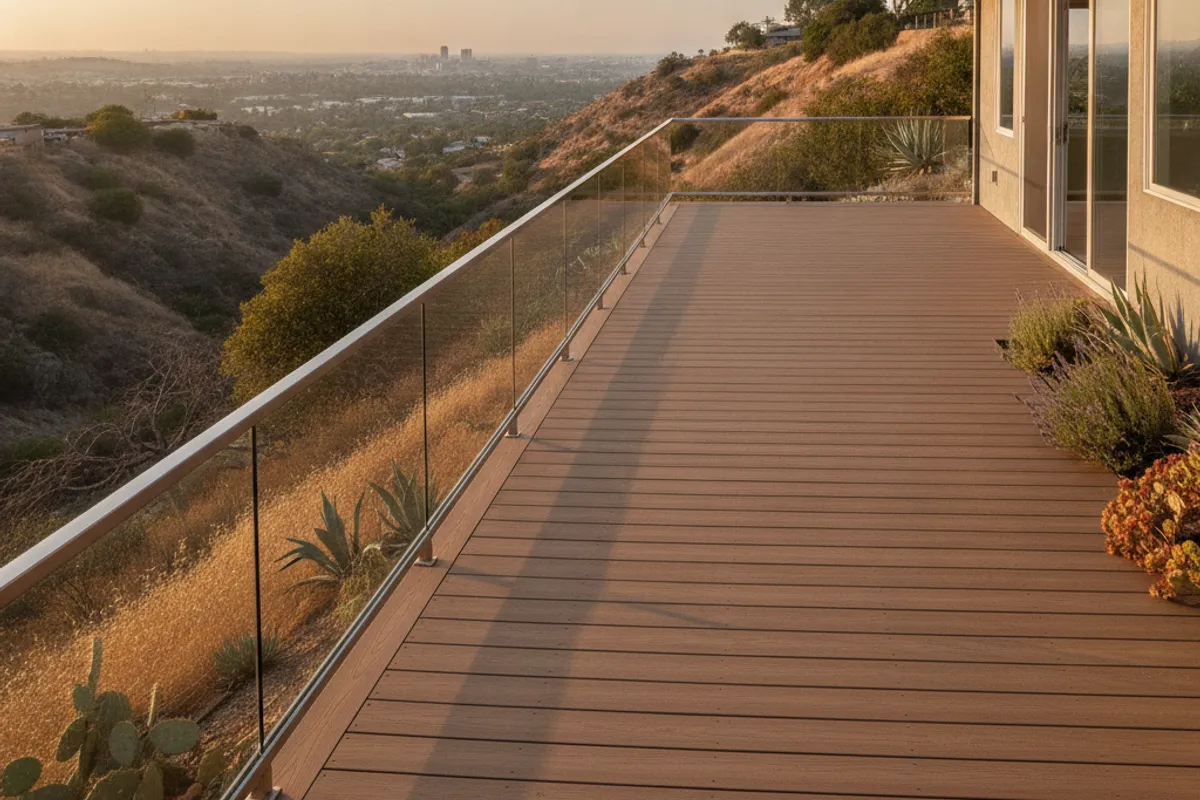
Fire regulations matter more here than almost anywhere
San Diego County has more land in designated fire hazard severity zones than most California counties, and the backcountry - Alpine, Descanso, Ramona, Jamul, Valley Center, Boulevard, and the foothill communities east of the I-15 corridor - has seen some of the most damaging wildfires in California history. The Cedar Fire, the Witch Creek Fire, and others left deep marks on how this county thinks about structure flammability.
When you’re building a deck on a property in a State Responsibility Area (SRA), a Very High Fire Hazard Severity Zone (VHFHSZ), or a Wildland-Urban Interface (WUI) zone, your material choices are not just aesthetic. They’re regulatory. The California Building Code (CBC) Chapter 7A and California Public Resources Code Section 4291 create real constraints on what goes on your deck.
This is a genuinely complicated area of code, and the rules change. What follows is an orientation - your contractor and the local building department are the authoritative sources for the current requirements on your specific parcel.
What the fire zone designations mean for decks
California’s fire hazard severity zone map designates areas as Moderate, High, or Very High. Most San Diego backcountry communities fall in High or Very High. State Responsibility Areas (SRA), where CalFire has primary jurisdiction, have additional requirements under the California Code of Regulations Title 14.
In these zones, new construction and significant renovation (the threshold varies - check with your local jurisdiction) must meet Chapter 7A requirements, which govern:
- Decking material fire resistance
- Fascia and soffits adjacent to the deck
- Vents and openings under the deck
- Spacing and clearance from combustible materials
The practical result: not every decking product on the market is approved for use in a fire zone. Some are conditionally approved. Some require specific installation details to meet code.
Approved and conditionally approved deck materials in fire zones
All-PVC decking (AZEK, WOLF PVC): All-PVC boards have no wood fiber content, which significantly reduces their ignition risk. Several all-PVC products are listed as meeting Chapter 7A requirements. Check the manufacturer’s current listings for specific product approvals - the WUI-approved list is maintained by the California Office of the State Fire Marshal.
Pressure-treated wood: Standard pressure-treated pine does not meet Chapter 7A ignition-resistant requirements by itself. Pressure-treated wood treated with fire retardant (FRTW - fire retardant treated wood) is a different product and may meet the requirements. FRTW is pressure-treated with fire retardant chemicals in addition to preservatives. It costs more and is not universally available, but it’s the path to using a wood-based product in a fire zone.
Standard composite decking: Many composite decking products, including some Trex and TimberTech PRO lines, do NOT carry Chapter 7A listing. The wood fiber content in the composite core does contribute to fire spread. Check the specific product’s Chapter 7A listing status before specifying for a fire zone project.
Certain capped composites and specialty products: Some manufacturers have pursued Chapter 7A testing and listing for specific products. Fiberon, for example, has products with WUI listings. Always verify against the current State Fire Marshal approved product listing, not just the manufacturer’s marketing materials.
Concrete and masonry: Poured concrete, concrete pavers, and masonry materials have no ignition risk and are fully compliant in any fire zone. Pool decks, patios, and grade-level surfaces in fire zones often use concrete for exactly this reason.
Ipe and other dense tropical hardwoods: Ipe is naturally very dense and fire-resistant relative to most softwoods, and some Ipe products carry favorable fire ratings. It’s one of the few natural wood options that has a realistic path in fire zone applications.
The ember intrusion problem: deck undersides and vents
California research on structure ignition in wildfires has consistently shown that ember intrusion - embers blown by wind entering through vents, under deck surfaces, or into eave spaces - is a primary ignition path. The deck surface itself is one source of risk, but the underside of an elevated deck is another.
Chapter 7A requirements for decks in fire zones address:
- Underside protection: Open framing under an elevated deck in a fire zone may require 1-hour fire-rated assemblies on the underside, or the space under the deck must be kept clear of combustibles. This affects deck design significantly for elevated decks.
- Vent screens: Any vents in the area below a deck must use 1/16-inch or smaller corrosion-resistant mesh. This blocks ember intrusion through openings.
- Deck board spacing: Tight-fitting deck boards with minimal gaps reduce the ember-catching surface area above the framing.
These requirements add design and material complexity that’s worth understanding before you finalize a deck plan in a backcountry community.
Defensible space and deck clearance
California law (PRC 4291) requires defensible space around structures in SRA and many LRA jurisdictions. Zone 1 (0-30 feet from the structure) requires cleared, maintained vegetation. This affects what you plant around the base of your deck, not the deck materials themselves, but it’s part of the fire-zone planning conversation.
A deck that extends into Zone 1 vegetation - landscaping close to the structure - can increase ignition risk if that vegetation is not managed. Keeping the area under and immediately around the deck free of combustible material (including stored wood, leaf litter, and dense low vegetation) is code-required and common sense.
Practical guidance for backcountry San Diego homeowners
If you’re building in Alpine, Descanso, Ramona, Valley Center, Jamul, or another backcountry community:
- Start by verifying your parcel’s fire hazard severity zone designation at the CAL FIRE FHSZ viewer (frap.fire.ca.gov)
- Confirm with your local building department which Chapter 7A provisions apply to your project
- Ask your contractor to specify only materials with current Chapter 7A listing for your zone
- Verify any contractor’s license at cslb.ca.gov and confirm they have specific experience with fire zone builds
For the full range of deck material options and the deck construction and permit process in San Diego County, those guides cover the non-fire-zone scenarios in detail.
Call (858) 400-4918 to get connected with a local deck crew that has experience with San Diego backcountry fire zone requirements.
What deck materials are allowed in San Diego fire zones?
Chapter 7A of the California Building Code governs materials in fire hazard severity zones. All-PVC decking (AZEK, WOLF) and fire retardant treated wood (FRTW) are common compliant options. Many standard composite products do not carry Chapter 7A listing. Confirm product approval against the current California State Fire Marshal listing.
Can I use Trex or TimberTech on a deck in Alpine or Ramona?
It depends on the specific product and its current Chapter 7A listing status. Some composite products from these manufacturers carry WUI approvals; others do not. Check the manufacturer’s current listing documentation and confirm with your local building department before specifying.
Do fire zone deck requirements affect the whole county?
No - the requirements apply to parcels in designated High or Very High Fire Hazard Severity Zones and State Responsibility Areas. Much of coastal and central San Diego County is not subject to Chapter 7A requirements. Backcountry and foothill communities east of the I-15 and I-8 corridors are most commonly affected.