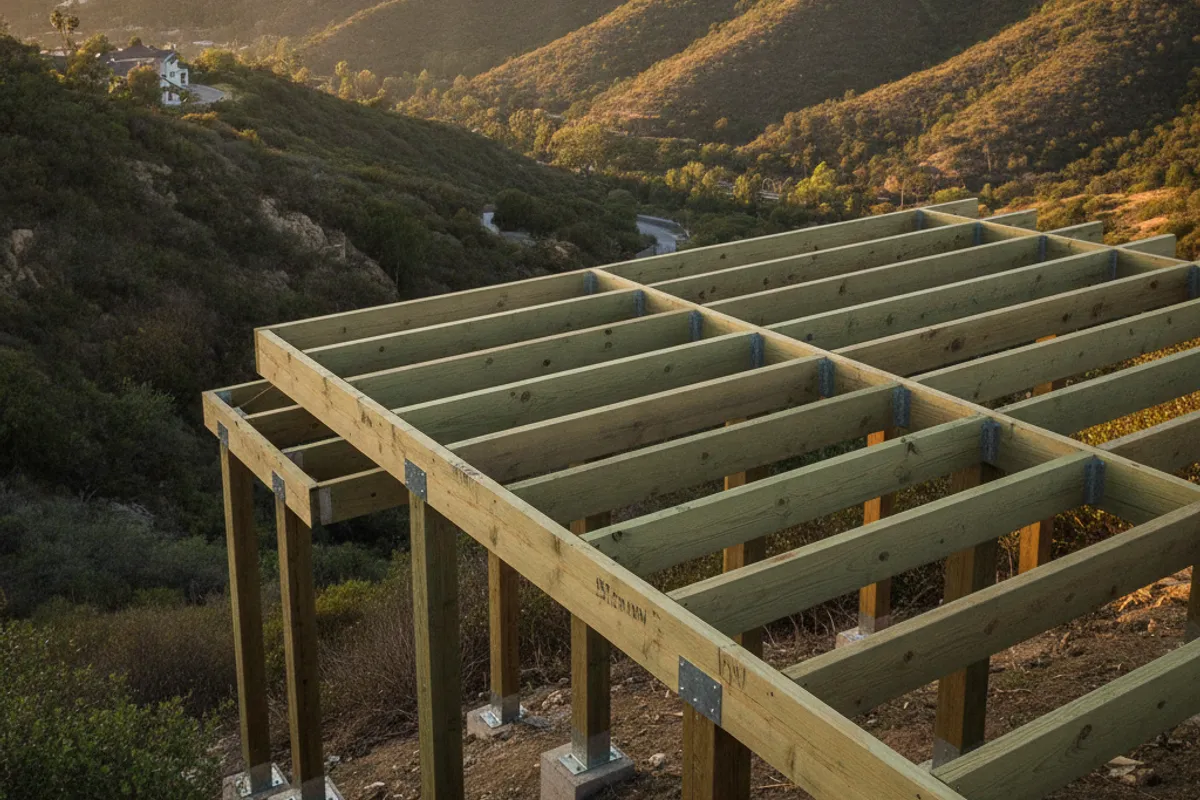
San Diego’s terrain makes deck framing interesting
A flat-lot deck is a different project from an elevated deck on a canyon rim in Tierrasanta, a hillside build in Mission Hills, or a steep backyard in Alpine. The framing principles are the same, but the scale, the engineering requirements, and the cost multiply fast when you’re building 8, 12, or 16 feet above the natural grade.
San Diego has more hillside lots than most California counties. The canyon system running through Clairemont, Linda Vista, Mission Hills, and into North Park; the foothill terrain in Escondido, Ramona, and Poway; the actual mountain-adjacent lots in Alpine and Descanso - all of these create common scenarios where a homeowner wants a usable outdoor space, but the backyard drops away from the house before it flattens.
This is what elevated deck framing involves, what it costs, and what to think through before you start.
How an elevated deck is different from a ground-level build
On a flat lot, a deck sits close to grade and posts are short - often 12-24 inches above the concrete footings. The framing loads are modest and the connections are straightforward.
On a hillside lot, the same deck platform may need posts that are 8, 12, or 16 feet tall to reach from the footing to the beam. Those longer posts carry larger bending loads when any lateral force (wind, seismic) is applied. The footings need to be deeper and wider. The connections at the top and bottom of each post are engineered differently. And the whole structure needs to work as a unit to resist the forces that would rack a taller frame.
That’s why elevated and hillside decks in San Diego almost always require a licensed structural engineer’s drawings before the city will issue a permit. The prescriptive methods in the California Residential Code cover simple low-level decks. Elevated decks need site-specific engineering.
Footing depth and type on hillside sites
Footings on hillside lots have to contend with two things that flat-lot footings don’t: slope stability and soil depth to firm bearing material.
San Diego has varied soil conditions. The marine terrace soils along the coast are relatively stable. The canyon rim areas in central San Diego often sit on expansive soils or fill. East county lots can have granitic decomposed granite (DG) that’s competent a few feet down, or clay soils that move seasonally with moisture changes. Some hillside lots in the urban canyon neighborhoods were graded decades ago and the fill compaction history is unknown.
A soils report - formal document from a licensed geotechnical engineer - is sometimes required for hillside deck permits. Even when it’s not required, it’s useful information if you have any doubt about what’s under the surface.
Typical footing sizes for an elevated deck in San Diego run 18-24 inches in diameter and 18-36 inches deep for a standard hillside build. Posts on steep sites sometimes require individual piers 4-6 feet deep to reach competent bearing material. The engineer determines this from soils data and the structural loads.
Post systems: what goes between the footing and the beam
For elevated decks, the posts are structural columns and their sizing is calculated by the engineer. Common configurations:
Single posts in tube form: 6x6 or 6x8 pressure-treated lumber posts anchored at the base to the footing with a code-approved post base connector. Common for moderate elevations (6-10 feet). The post base connector must be specified for the post size and load.
Steel column tubes: Some hillside builds use structural steel pipe or tube columns, especially for higher elevations or tighter space constraints. Steel allows longer spans with smaller cross-sections. More expensive but sometimes the right call for a specific geometry.
Knee brace framing: For elevated decks, horizontal bracing at mid-height or diagonal knee braces between adjacent posts significantly improve lateral resistance. These are engineered in based on height and wind/seismic loads.
The structural connections at every joint - post base, post cap, beam splice, joist hanger - are specified by size, type, and fastener count in the engineer’s drawings. This is not a place to substitute what’s on hand for what’s specified.
Ledger attachment on hillside homes
An elevated deck is most often attached to the house via a ledger board - a beam bolted to the house’s rim joist or band board. This attachment transfers part of the deck’s load to the house structure, which simplifies the footing design but requires that the attachment be engineered correctly.
On homes with exterior cladding in San Diego, the ledger attachment requires proper flashing to keep water out of the wall assembly. Getting the flashing wrong on a ledger attachment is one of the more common sources of water damage in wood-frame homes. The detail involves a flashing membrane behind the cladding, a metal Z-flashing over the top of the ledger, and proper drainage between the ledger and the siding.
Freestanding decks - where the structure is entirely self-supporting on its own posts, not attached to the house - avoid the ledger detail but require more posts and a more complex footing plan. On some hillside sites where the attachment to the house is complicated by the roof overhang geometry or the foundation type, freestanding is actually the simpler build.
Seismic considerations
San Diego is seismic country. The Elsinore and Rose Canyon fault systems run through the county, and the building code requires that structures be designed for lateral forces. For an elevated deck, this means the engineer’s drawings will include details for the deck to resist lateral movement in both horizontal directions, not just gravity loads.
This is handled through the combination of footing embedment depth, post-to-beam connections, and horizontal diaphragm stiffness in the deck framing. On well-engineered elevated decks, these connections are slightly overbuilt relative to pure gravity calculations. It’s appropriate.
What elevated deck framing costs in San Diego
The framing and substructure of an elevated deck costs significantly more than the same deck at grade. Rough ranges for San Diego builds:
- Modest elevation (3-6 feet), 300 sq ft deck: add $4,000-$10,000 over a ground-level build
- Moderate elevation (6-12 feet), 300-400 sq ft: add $10,000-$20,000
- Significant elevation (12+ feet), complex hillside site: add $20,000-$40,000+
Engineering costs add $800-$2,500 depending on complexity. Soils report, when needed, adds another $1,500-$3,000.
Total project cost for a 400 sq ft composite deck on a significant hillside lot in Poway or Alpine can easily reach $45,000-$65,000. That’s not a number that shows up in national deck cost averages.
For the full permit process for elevated decks, see the deck permits and setbacks guide. For the complete decking material choices that go on top of this framing, see the deck construction and materials guide.
Verify any contractor’s structural credentials and license status at cslb.ca.gov before hiring. Elevated deck work in California requires an active contractor’s license and general liability insurance - confirm both before signing anything.
Call (858) 400-4918 to connect with a local crew experienced with hillside deck framing in San Diego County.
How much does an elevated deck cost in San Diego?
Elevated decks in San Diego cost significantly more than ground-level builds. A moderate hillside deck at 6-12 feet of elevation adds $10,000-$20,000 over a comparable ground-level project. Very steep hillside builds with significant framing complexity can run $45,000-$70,000 for a mid-size composite deck.
Do elevated decks in San Diego need an engineer?
Yes, in most cases. Decks over 30 inches above grade typically require engineered structural drawings for the building permit in San Diego County and most incorporated cities. The engineer specifies footing depth, post sizing, and connection hardware based on the actual loads and site conditions.
What kind of posts are used for elevated decks?
Pressure-treated 6x6 or 6x8 lumber posts are standard for residential elevated decks in San Diego at moderate heights. For higher elevations or tighter space constraints, some builds use structural steel tube columns. The engineer specifies the post size and material based on height, spacing, and load.